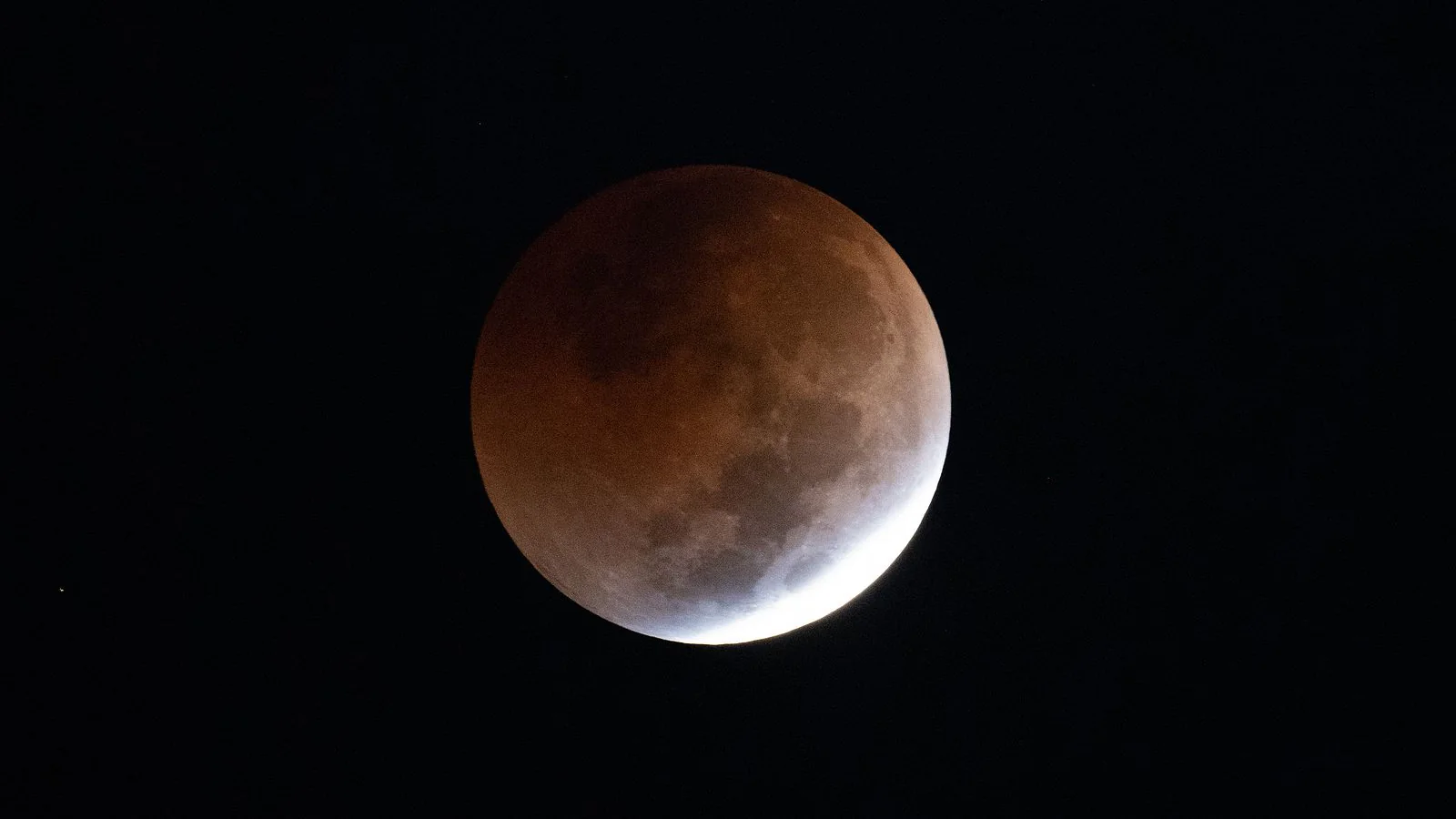
Visible from the Americas, Europe, Africa, Middle East
What happens
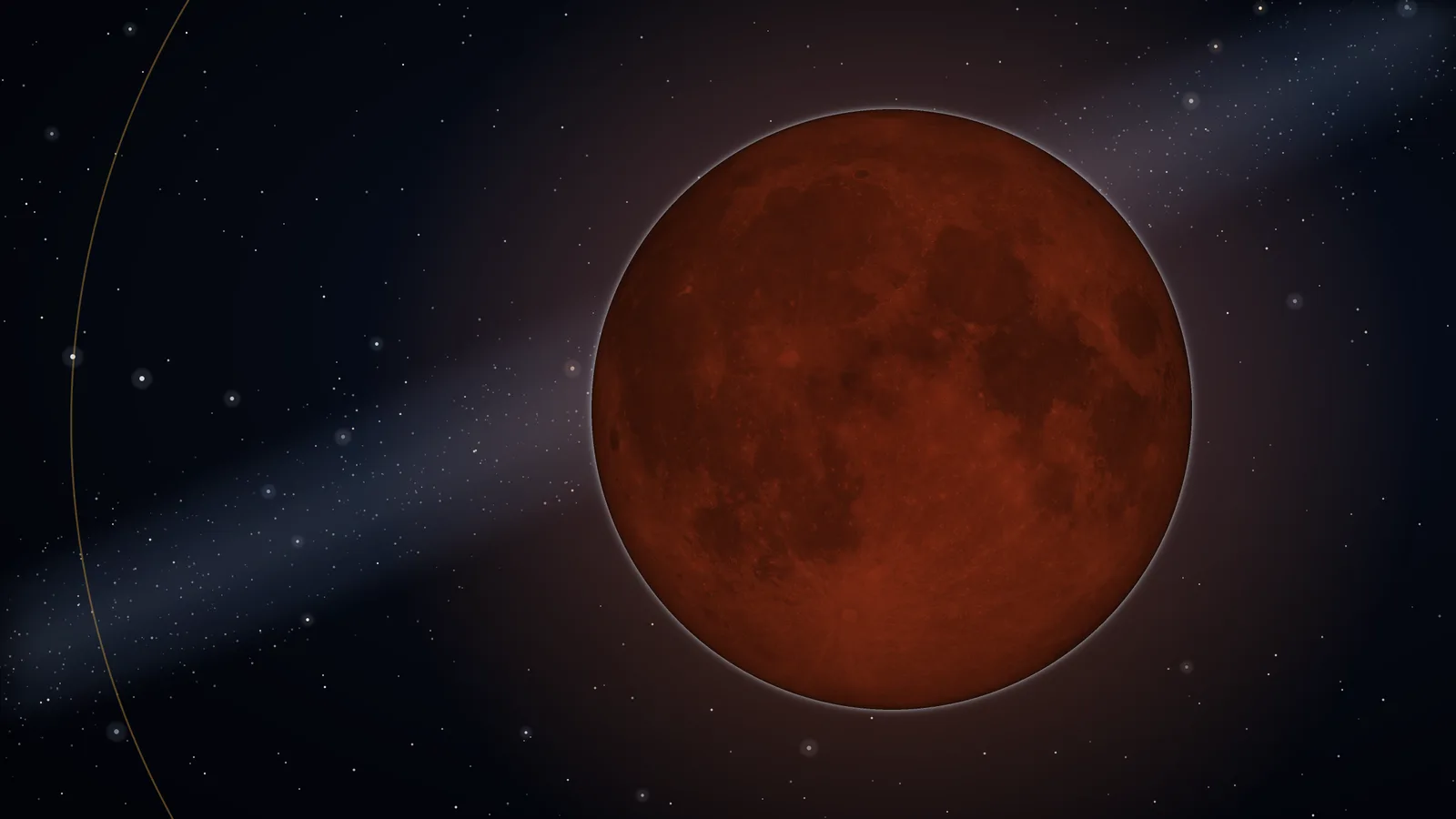
On 26 Jun 2029 the full Moon passes through the Earth’s shadow. For 1 h 42 min it lies entirely inside the umbra, the shadow’s dark core, and turns a dull red or copper — sometimes called a “blood moon”.
It does not go black because the Earth’s atmosphere bends some sunlight into the shadow. On the way through it scatters away the blue, so the light that reaches the Moon is red: the light of every sunrise and sunset on Earth at that moment. How dark and how red depends on the dust and cloud in the atmosphere, and nobody can predict it exactly.
That night the Moon is about 373,000 km away, close to its average distance.
The Moon’s distance is computed by Orbira (Astronomical Almanac low-precision formulae).
The Moon in the Earth’s shadow
Timeline (UT)
A lunar eclipse looks the same from everywhere the Moon is up: these moments happen at the same instant for everyone, whatever the local clock says.
| UT | What happens |
|---|---|
| 00:35 | The Moon enters the penumbra; the dimming is too slight to see at first. |
| 01:32 | The partial eclipse begins: the Moon starts to enter the umbra. |
| 02:31 | Totality begins: the whole Moon is inside the umbra. |
| 03:22 | Greatest eclipse. |
| 04:13 | Totality ends. |
| 05:12 | The partial eclipse ends. |
| 06:10 | The Moon leaves the penumbra; the eclipse is over. |
Greatest eclipse and the durations are NASA’s; the other times are placed symmetrically around greatest eclipse, within a minute or two of NASA’s contact times.
From these cities
Anyone who can see the Moon at the time can see the eclipse — there is no path, and about half the planet has the Moon above the horizon. NASA lists the Americas, Europe, Africa, Middle East. The times below are each city’s own clock, and the last column says whether the Moon is up for all of it there, or rises or sets part of the way through.
| City | Partial begins | Totality | Partial ends | What you can see |
|---|---|---|---|---|
| São Paulo, Brazil | Mon 25 Jun, 22:32 | 23:31–01:13 | 02:12 | All of it; the Moon 87° high at greatest |
| Buenos Aires, Argentina | Mon 25 Jun, 22:32 | 23:31–01:13 | 02:12 | All of it; the Moon 76° high at greatest |
| Santiago, Chile | Mon 25 Jun, 21:32 | 22:31–00:13 | 01:12 | All of it; the Moon 69° high at greatest |
| Lima, Peru | Mon 25 Jun, 20:32 | 21:31–23:13 | 00:12 | All of it; the Moon 62° high at greatest |
| Quito, Ecuador | Mon 25 Jun, 20:32 | 21:31–23:13 | 00:12 | All of it; the Moon 54° high at greatest |
| Bogotá, Colombia | Mon 25 Jun, 20:32 | 21:31–23:13 | 00:12 | All of it; the Moon 53° high at greatest |
| Cape Town, South Africa | Tue 26 Jun, 03:32 | 04:31–06:13 | 07:12 | All of it; the Moon 30° high at greatest |
| Lagos, Nigeria | Tue 26 Jun, 02:32 | 03:31–05:13 | 06:12 | All of it; the Moon 30° high at greatest |
| Mexico City, Mexico | Mon 25 Jun, 19:32 | 20:31–22:13 | 23:12 | All of it; the Moon 26° high at greatest |
| New York, United States | Mon 25 Jun, 21:32 | 22:31–00:13 | 01:12 | All of it; the Moon 22° high at greatest |
| Casablanca, Morocco | Tue 26 Jun, 01:32 | 02:31–04:13 | 05:12 | All of it; the Moon 20° high at greatest |
| Tangier, Morocco | Tue 26 Jun, 01:32 | 02:31–04:13 | 05:12 | All of it; the Moon 18° high at greatest |
| Toronto, Canada | Mon 25 Jun, 21:32 | 22:31–00:13 | 01:12 | All of it; the Moon 18° high at greatest |
| Lisbon, Portugal | Tue 26 Jun, 02:32 | 03:31–05:13 | 06:12 | All of it; the Moon 17° high at greatest |
| Chicago, United States | Mon 25 Jun, 20:32 | 21:31–23:13 | 00:12 | All of it; the Moon 16° high at greatest |
| Johannesburg, South Africa | Tue 26 Jun, 03:32 | 04:31–06:13 | 07:12 | The Moon sets at 07:00, before the end |
Computed by Orbira: the Moon is within about a degree of the point opposite the Sun during a lunar eclipse, so rising and setting times are good to a few minutes.
The eclipse’s family
It belongs to Saros series 130. A saros is 18 years, 11 days and 8 hours: after it the Sun, the Moon and the Moon’s orbit line up again almost exactly, so the eclipses of one series are near-repeats of each other. The one before this was on 15 Jun 2011; the next will be on 7 Jul 2047.
Saros series from NASA’s decade table; the previous and next dates are this eclipse’s ± one saros, computed by Orbira.
How to observe
- A lunar eclipse is safe to watch with the naked eye, binoculars or a telescope.
- It can be seen from wherever the Moon is above the horizon while it happens — the regions listed here.