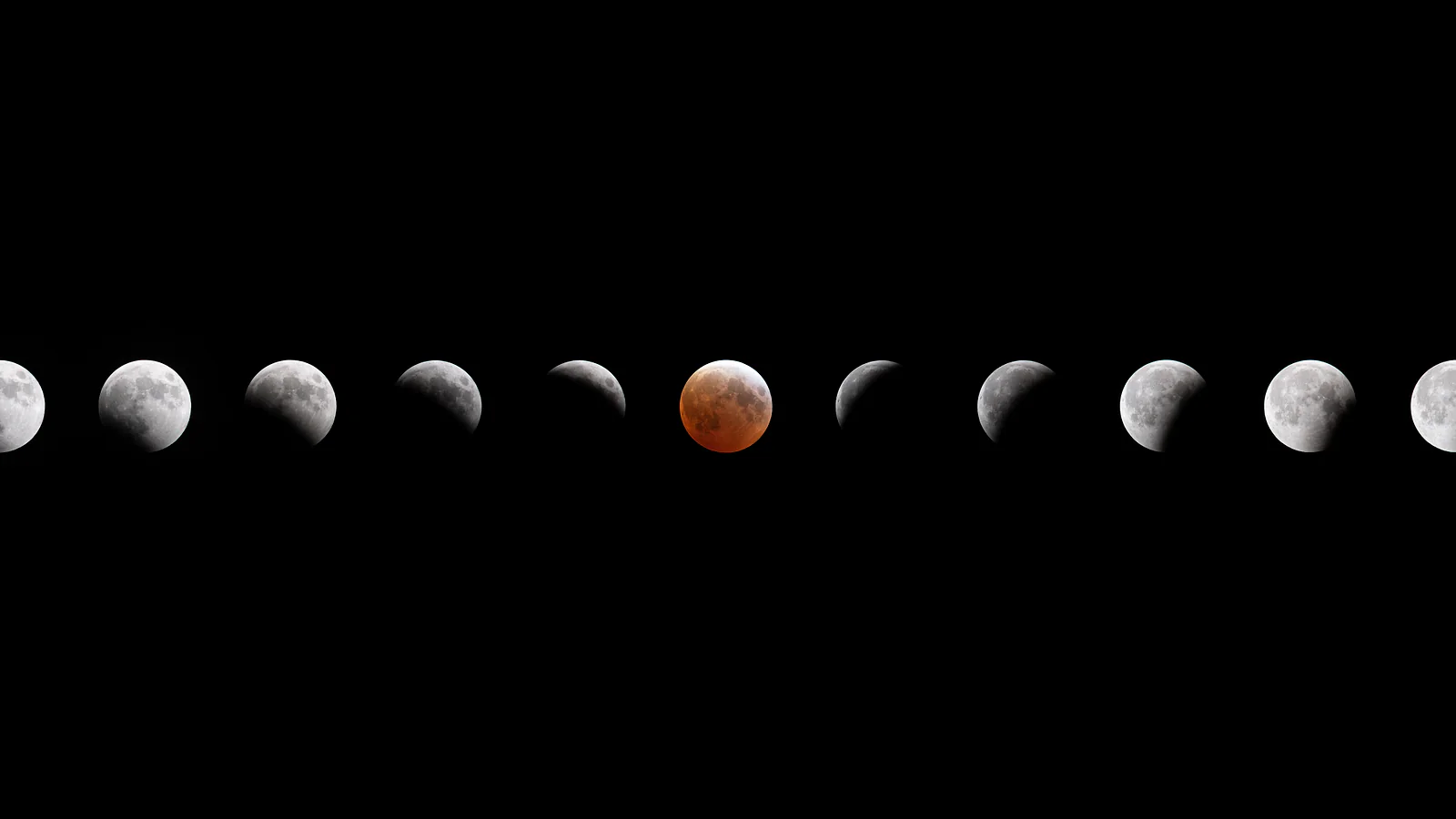
Visible from the Americas, Europe, Africa, Asia
What happens
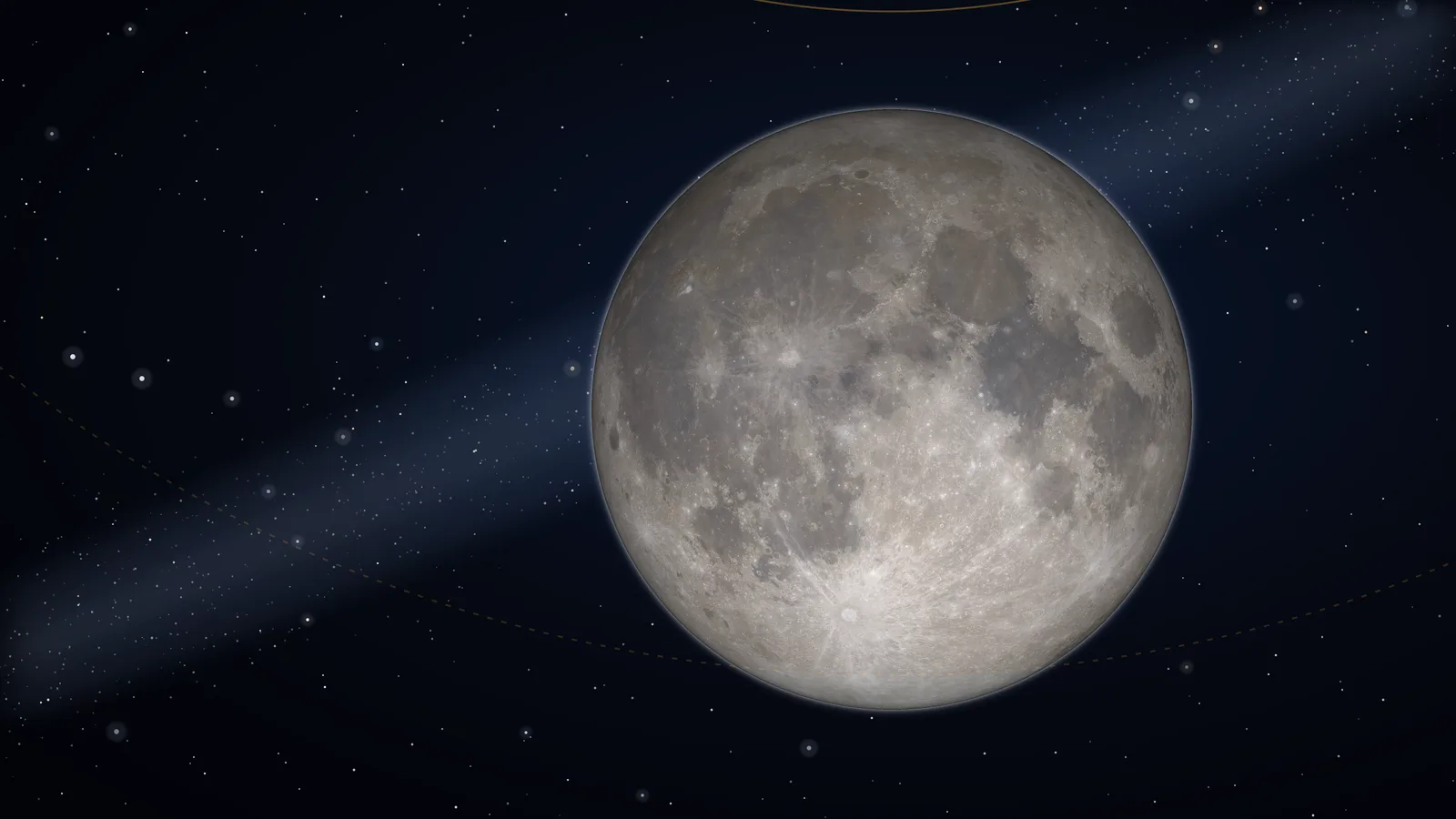
On 9 Dec 2030 the full Moon passes only through the penumbra, the faint outer shadow where the Earth blocks part of the Sun. At most 94% of its diameter is inside it.
The Moon dims slightly, most on the side nearest the shadow’s core; many people notice nothing at all. A camera with a fixed exposure shows it more clearly than the eye.
That night the Moon is about 406,000 km away, farther than average (384,400 km), so it looks slightly smaller than usual.
The Moon’s distance is computed by Orbira (Astronomical Almanac low-precision formulae).
The Moon in the Earth’s shadow
Timeline (UT)
A lunar eclipse looks the same from everywhere the Moon is up: these moments happen at the same instant for everyone, whatever the local clock says.
| UT | What happens |
|---|---|
| 20:08 | The Moon enters the penumbra; the dimming is too slight to see at first. |
| 22:28 | Greatest eclipse. |
| 00:47 | The Moon leaves the penumbra; the eclipse is over. |
Greatest eclipse and the durations are NASA’s; the other times are placed symmetrically around greatest eclipse, within a minute or two of NASA’s contact times.
From these cities
Anyone who can see the Moon at the time can see the eclipse — there is no path, and about half the planet has the Moon above the horizon. NASA lists the Americas, Europe, Africa, Asia. The times below are each city’s own clock, and the last column says whether the Moon is up for all of it there, or rises or sets part of the way through.
| City | Penumbral begins | Greatest | Penumbral ends | What you can see |
|---|---|---|---|---|
| Luxor, Egypt | Mon 9 Dec, 22:08 | 00:27 | 02:47 | All of it; the Moon 79° high at greatest |
| Cairo, Egypt | Mon 9 Dec, 22:08 | 00:27 | 02:47 | All of it; the Moon 79° high at greatest |
| Athens, Greece | Mon 9 Dec, 22:08 | 00:27 | 02:47 | All of it; the Moon 75° high at greatest |
| Jeddah, Saudi Arabia | Mon 9 Dec, 23:08 | 01:27 | 03:47 | All of it; the Moon 73° high at greatest |
| Tunis, Tunisia | Mon 9 Dec, 21:08 | 23:27 | 01:47 | All of it; the Moon 73° high at greatest |
| Istanbul, Türkiye | Mon 9 Dec, 23:08 | 01:27 | 03:47 | All of it; the Moon 71° high at greatest |
| Rome, Italy | Mon 9 Dec, 21:08 | 23:27 | 01:47 | All of it; the Moon 70° high at greatest |
| Algiers, Algeria | Mon 9 Dec, 21:08 | 23:27 | 01:47 | All of it; the Moon 69° high at greatest |
| Riyadh, Saudi Arabia | Mon 9 Dec, 23:08 | 01:27 | 03:47 | All of it; the Moon 67° high at greatest |
| Lagos, Nigeria | Mon 9 Dec, 21:08 | 23:27 | 01:47 | All of it; the Moon 66° high at greatest |
| Milan, Italy | Mon 9 Dec, 21:08 | 23:27 | 01:47 | All of it; the Moon 65° high at greatest |
| Málaga, Spain | Mon 9 Dec, 21:08 | 23:27 | 01:47 | All of it; the Moon 64° high at greatest |
| Tangier, Morocco | Mon 9 Dec, 20:08 | 22:27 | 00:47 | All of it; the Moon 63° high at greatest |
| Madrid, Spain | Mon 9 Dec, 21:08 | 23:27 | 01:47 | All of it; the Moon 63° high at greatest |
| Casablanca, Morocco | Mon 9 Dec, 20:08 | 22:27 | 00:47 | All of it; the Moon 63° high at greatest |
| Seville, Spain | Mon 9 Dec, 21:08 | 23:27 | 01:47 | All of it; the Moon 63° high at greatest |
Computed by Orbira: the Moon is within about a degree of the point opposite the Sun during a lunar eclipse, so rising and setting times are good to a few minutes.
The eclipse’s family
It belongs to Saros series 145. A saros is 18 years, 11 days and 8 hours: after it the Sun, the Moon and the Moon’s orbit line up again almost exactly, so the eclipses of one series are near-repeats of each other. The one before this was on 28 Nov 2012; the next will be on 20 Dec 2048.
Saros series from NASA’s decade table; the previous and next dates are this eclipse’s ± one saros, computed by Orbira.
How to observe
- A lunar eclipse is safe to watch with the naked eye, binoculars or a telescope.
- It can be seen from wherever the Moon is above the horizon while it happens — the regions listed here.
- A penumbral eclipse is subtle: the Moon dims slightly, and many people do not notice it.