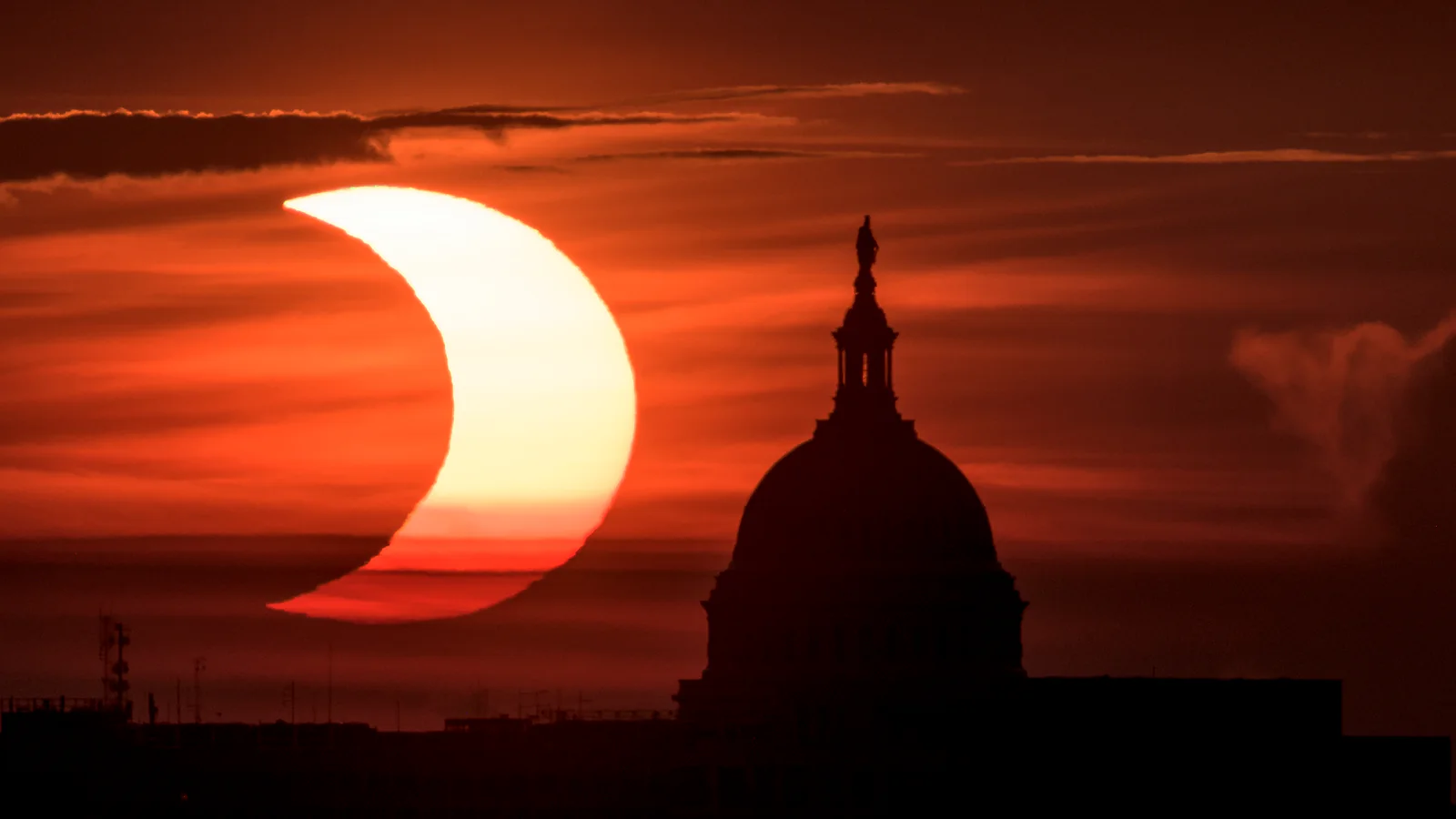
Annular across Ecuador, Peru, Brazil, Suriname, Spain, Portugal
What happens
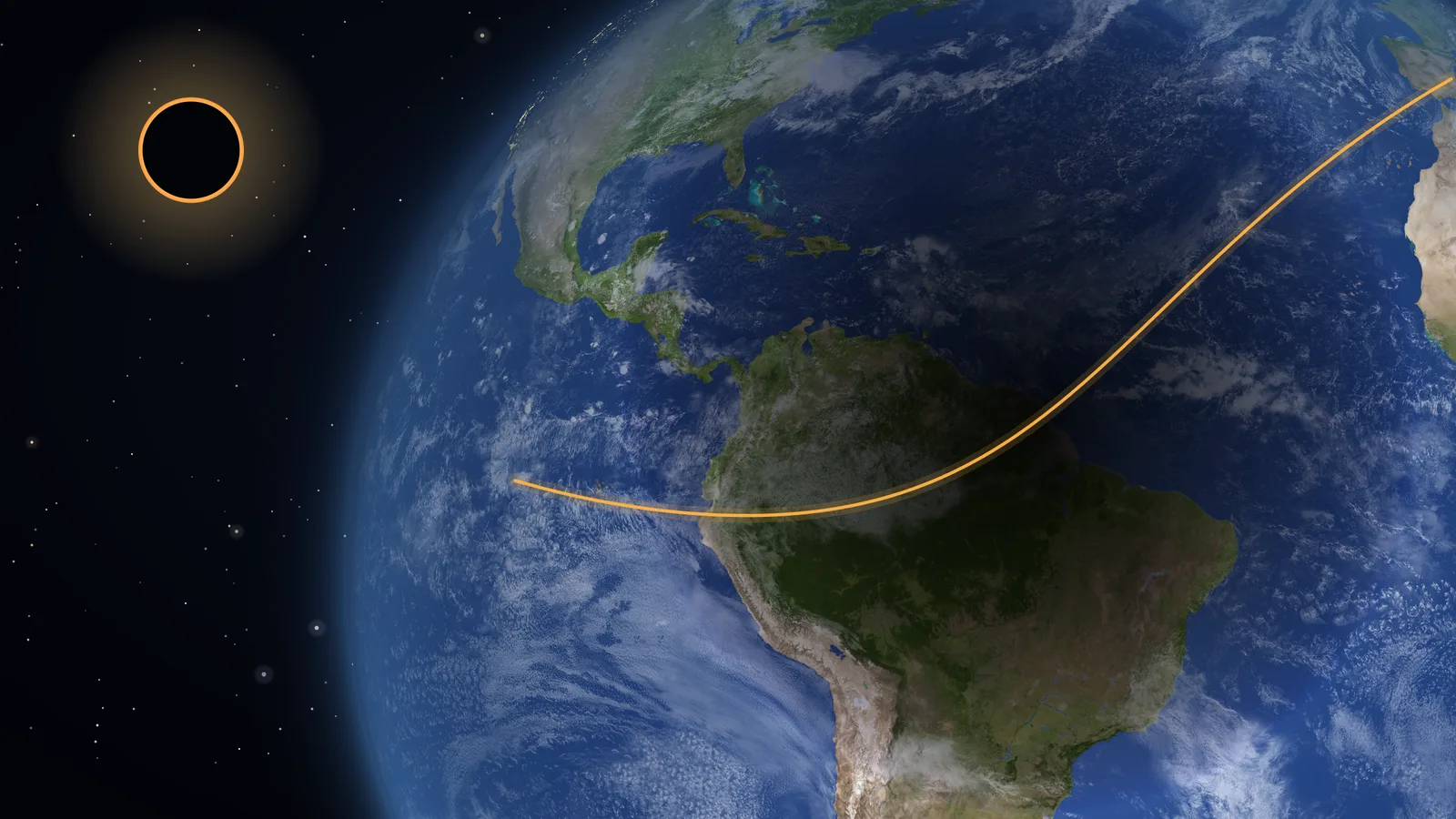
On 26 Jan 2028 the Moon passes directly between the Sun and the Earth, but near the far point of its orbit, where it looks slightly smaller than the Sun. Even on the central line it cannot cover the Sun: along a path across Ecuador, Peru, Brazil, Suriname, Spain, Portugal it leaves a bright ring — the “ring of fire” — for up to 10 min 27 s.
Across eastern North America, Central and South America, western Europe, northwestern Africa the Moon covers only part of the Sun. The Sun is never safe to look at during an annular eclipse, not even at its deepest.
At greatest eclipse the path of annularity is about 325 km wide, and the shadow crosses the ground at about 1,700 km/h — faster still near the ends of the path, where it meets the Earth at a slant. That is why annularity anywhere lasts minutes, not hours, and why a few kilometres decide whether a place sees it at all.
Path width and shadow speed computed by Orbira from NASA’s Besselian elements.
Where the shadow falls
Timeline (UT)
From first to last contact the eclipse lasts 6 h 3 min somewhere on Earth; any one place sees two or three hours of it at most.
| UT | What happens |
|---|---|
| 12:07 | The Moon’s shadow first touches the Earth: a partial eclipse begins somewhere on the planet. |
| 13:19 | The annular phase begins on the central line, over the Pacific Ocean. |
| 15:07 | Greatest eclipse, over South America — annularity lasts 10 min 27 s there. |
| 16:57 | The annular phase ends on the central line, over Europe. |
| 18:10 | The shadow leaves the Earth: the eclipse is over everywhere. |
Greatest eclipse is NASA’s. The other times are computed by Orbira from NASA’s Besselian elements for a spherical Earth, within a few minutes.
From these cities
When the eclipse begins and ends in each city, how much of the Sun the Moon covers at its deepest, and where to look: the Sun’s height above the horizon and its direction at that moment. Times are each city’s own clock. Cities from which the Sun is below the horizon throughout are left out.
Where the Sun rises or sets already eclipsed, the table says so: a low Sun needs a clear, flat horizon in its direction.
| City | Begins | Deepest | Ends | Sun covered | Sun at deepest |
|---|---|---|---|---|---|
| Tangier, Morocco | 15:34 | 16:56 | at sunset, 17:39 | Annular, 16:55–16:57 (2 min 47 s) | 8° high, south-west |
| Seville, Spain | 16:34 | 17:56 | at sunset, 18:36 | Annular, 17:52–17:59 (7 min 15 s) | 7° high, south-west |
| Málaga, Spain | 16:36 | 17:56 | at sunset, 18:32 | Annular, 17:54–17:59 (4 min 57 s) | 6° high, south-west |
| Madrid, Spain | 16:36 | 17:55 | at sunset, 18:20 | 82% | 4° high, south-west |
| Lisbon, Portugal | 15:31 | 16:54 | at sunset, 17:46 | 81% | 9° high, south-west |
| Casablanca, Morocco | 15:33 | 16:56 | at sunset, 17:51 | 80% | 10° high, south-west |
| Quito, Ecuador | 07:13 | 08:42 | 10:34 | 78% | 32° high, east |
| Algiers, Algeria | 16:42 | 17:58 | at sunset, 18:02 | 77% | 1° high, south-west |
| Lima, Peru | 07:11 | 08:37 | 10:22 | 65% | 36° high, east |
| Bogotá, Colombia | 07:22 | 08:57 | 10:55 | 63% | 37° high, south-east |
| Paris, France | 16:37 | 17:32 | at sunset, 17:32 | 52% | 0° high, south-west |
| London, United Kingdom | 15:36 | 16:32 | at sunset, 16:32 | 49% | 0° high, south-west |
| Tunis, Tunisia | 16:47 | 17:33 | at sunset, 17:33 | 45% | 0° high, south-west |
| Mexico City, Mexico | at sunrise, 07:16 | 07:35 | 08:52 | 36% | 4° high, east |
| Milan, Italy | 16:42 | 17:15 | at sunset, 17:15 | 30% | 0° high, south-west |
| Rome, Italy | 16:45 | 17:12 | at sunset, 17:12 | 22% | 0° high, south-west |
Computed by Orbira from NASA’s Besselian elements for the Earth’s true shape (WGS 84), at sea level: coverage within about a percent, times within a minute. Durations are to the nearest 10 s. The edges of the path agree with NASA’s to about 100 m; a city right on one is said to be at the edge.
Why the Moon can hide the Sun
The Sun is about 400 times wider than the Moon and about 400 times farther away, so the two look almost exactly the same size in our sky. The Moon’s orbit is slightly oval: near its closest it looks a little larger than the Sun and can cover it completely, a total eclipse; near its farthest it looks a little smaller and leaves a ring, an annular eclipse.
The magnitude, 0.9208, is the fraction of the Sun’s diameter the Moon covers at greatest eclipse.
It belongs to Saros series 141. A saros is 18 years, 11 days and 8 hours: after it the Sun, the Moon and the Moon’s orbit line up again almost exactly, so the eclipses of one series are near-repeats of each other, each falling about a third of the way round the globe further west. The one before this was on 15 Jan 2010; the next will be on 5 Feb 2046.
Saros series from NASA’s decade table; the previous and next dates are this eclipse’s ± one saros, computed by Orbira.
How to observe — safely
- Never look at the Sun directly, or through a camera, binoculars or a telescope, without a solar filter made for it — not even when most of it is covered.
- Use eclipse glasses that meet the ISO 12312-2 standard, or watch the Sun’s image projected through a pinhole.
- An annular or partial eclipse never becomes safe to look at without protection.