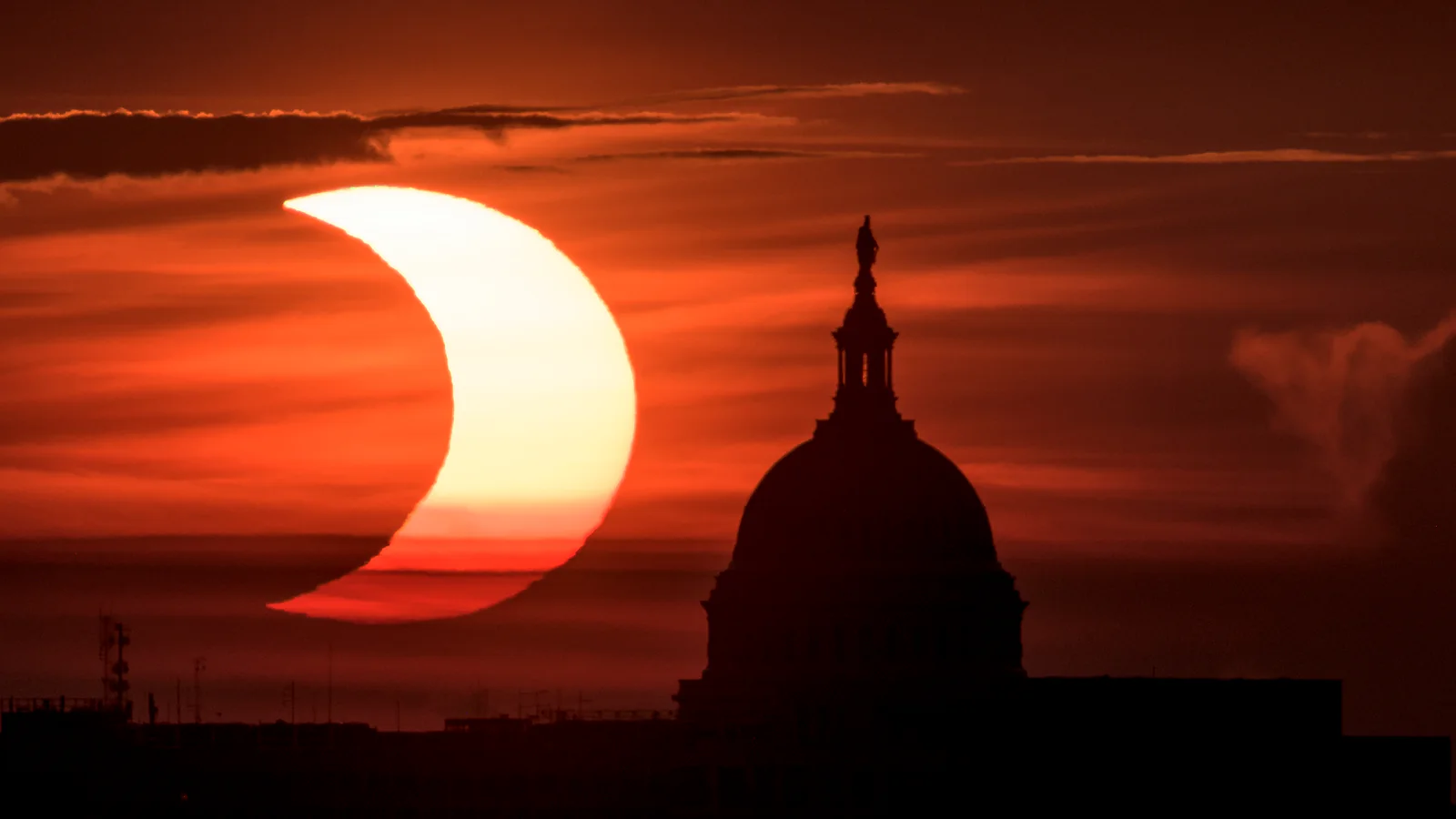
Partial, visible from southern Chile, southern Argentina
What happens
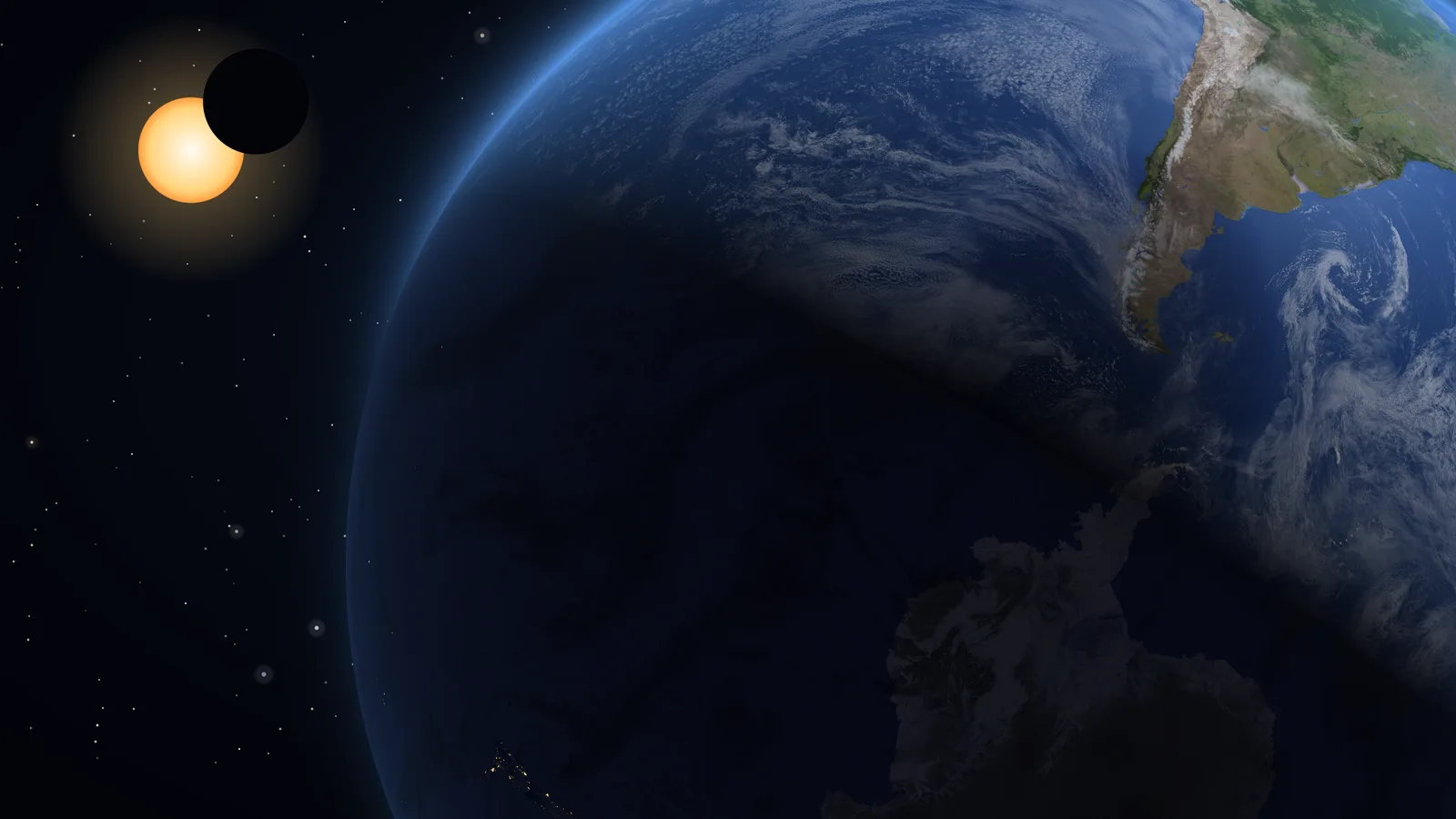
On 11 Jul 2029 the Moon passes between the Sun and the Earth slightly off line: its central shadow misses the planet, so nowhere sees the Sun fully covered. From southern Chile, southern Argentina the Moon takes a bite out of the Sun.
At greatest eclipse, the deepest anywhere, the Moon covers 23% of the Sun’s diameter.
Where the shadow falls
Timeline (UT)
From first to last contact the eclipse lasts 2 h 18 min somewhere on Earth; any one place sees two or three hours of it at most.
| UT | What happens |
|---|---|
| 14:28 | The Moon’s shadow first touches the Earth: a partial eclipse begins somewhere on the planet. |
| 15:36 | Greatest eclipse. |
| 16:46 | The shadow leaves the Earth: the eclipse is over everywhere. |
Greatest eclipse is NASA’s. The other times are computed by Orbira from NASA’s Besselian elements for a spherical Earth, within a few minutes.
Why the Moon can hide the Sun
The Sun is about 400 times wider than the Moon and about 400 times farther away, so the two look almost exactly the same size in our sky. The Moon’s orbit is slightly oval: near its closest it looks a little larger than the Sun and can cover it completely, a total eclipse; near its farthest it looks a little smaller and leaves a ring, an annular eclipse.
The magnitude, 0.2304, is the fraction of the Sun’s diameter the Moon covers at greatest eclipse.
It belongs to Saros series 156. A saros is 18 years, 11 days and 8 hours: after it the Sun, the Moon and the Moon’s orbit line up again almost exactly, so the eclipses of one series are near-repeats of each other, each falling about a third of the way round the globe further west. The one before this was on 1 Jul 2011; the next will be on 22 Jul 2047.
Saros series from NASA’s decade table; the previous and next dates are this eclipse’s ± one saros, computed by Orbira.
How to observe — safely
- Never look at the Sun directly, or through a camera, binoculars or a telescope, without a solar filter made for it — not even when most of it is covered.
- Use eclipse glasses that meet the ISO 12312-2 standard, or watch the Sun’s image projected through a pinhole.
- An annular or partial eclipse never becomes safe to look at without protection.