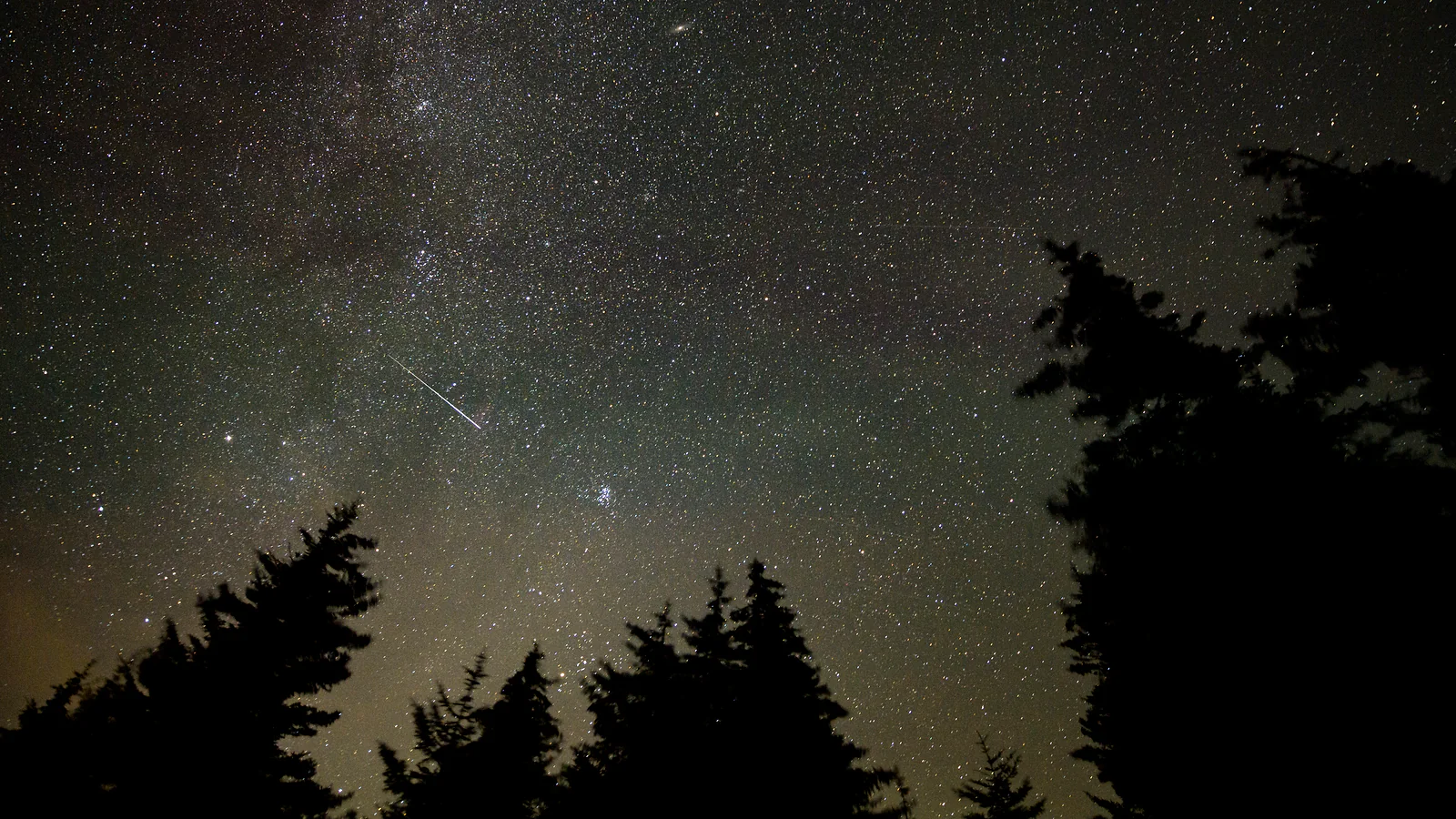
When the Ursids peak
The next returns, each with the Moon at the peak: its light decides how many of the fainter meteors can be seen.
| Year | Peak, UTC | Moon at the peak | That night |
|---|---|---|---|
| 2026 | 98% lit, fullBright Moon: only the brightest meteors | City by city | |
| 2027 | 21% lit, a waning crescentDark sky: a good year | City by city | |
| 2028 | 36% lit, a waxing crescentSome moonlight | Nearer the date | |
| 2029 | 97% lit, a waning gibbousBright Moon: only the brightest meteors | Nearer the date |
Computed by Orbira from IMO’s solar longitude of the maximum, 270.7°: an estimate — a given return can peak some hours either side. Moon phase computed at the estimated peak (Meeus, low-accuracy formula).
What you will see
At their peak the Ursids can produce up to 10 meteors an hour for one observer under a perfectly dark sky. They seem to fly out of one point in Ursa Minor — the radiant — but they can appear anywhere in the sky, so there is no need to stare at the constellation itself.
They strike the atmosphere at 33 km/s, about 119,000 km/h, and burn up high above the ground, typically between 70 and 120 km up. At this speed they cross the sky slowly enough to follow with the eye.
Where they come from
The Ursids are debris shed by comet 8P/Tuttle. Every year the Earth crosses that trail of dust between 17 Dec and 26 Dec. Most of the grains are smaller than a grain of sand; it is their speed, not their size, that makes them shine.
The peak comes when the Earth passes through the densest part of the trail, at the same point of its orbit every year — solar longitude 270.7° in IMO's calendar. That is why the date moves by a day at most from one year to the next. A given return can peak some hours either side of IMO's mean.
What the rate means
10 is the zenithal hourly rate (ZHR): what one observer would count in an hour if the sky were perfectly dark — stars visible down to magnitude 6.5 — and the radiant were straight overhead. Real counts are almost always lower.
With the radiant 30° above the horizon you would see about half of it; under a suburban sky, a third or less. Best from the Northern Hemisphere. Showers are usually richest after midnight, when your side of the Earth faces forward along its orbit and sweeps up more of the dust.
How to observe
- Find a dark place away from city lights and give your eyes about twenty minutes to adapt.
- Lie back and look at a wide area of sky: meteors appear all over it, not only near the radiant.
- The rate here is an ideal. Moonlight, light pollution and a low radiant mean most people see far fewer.