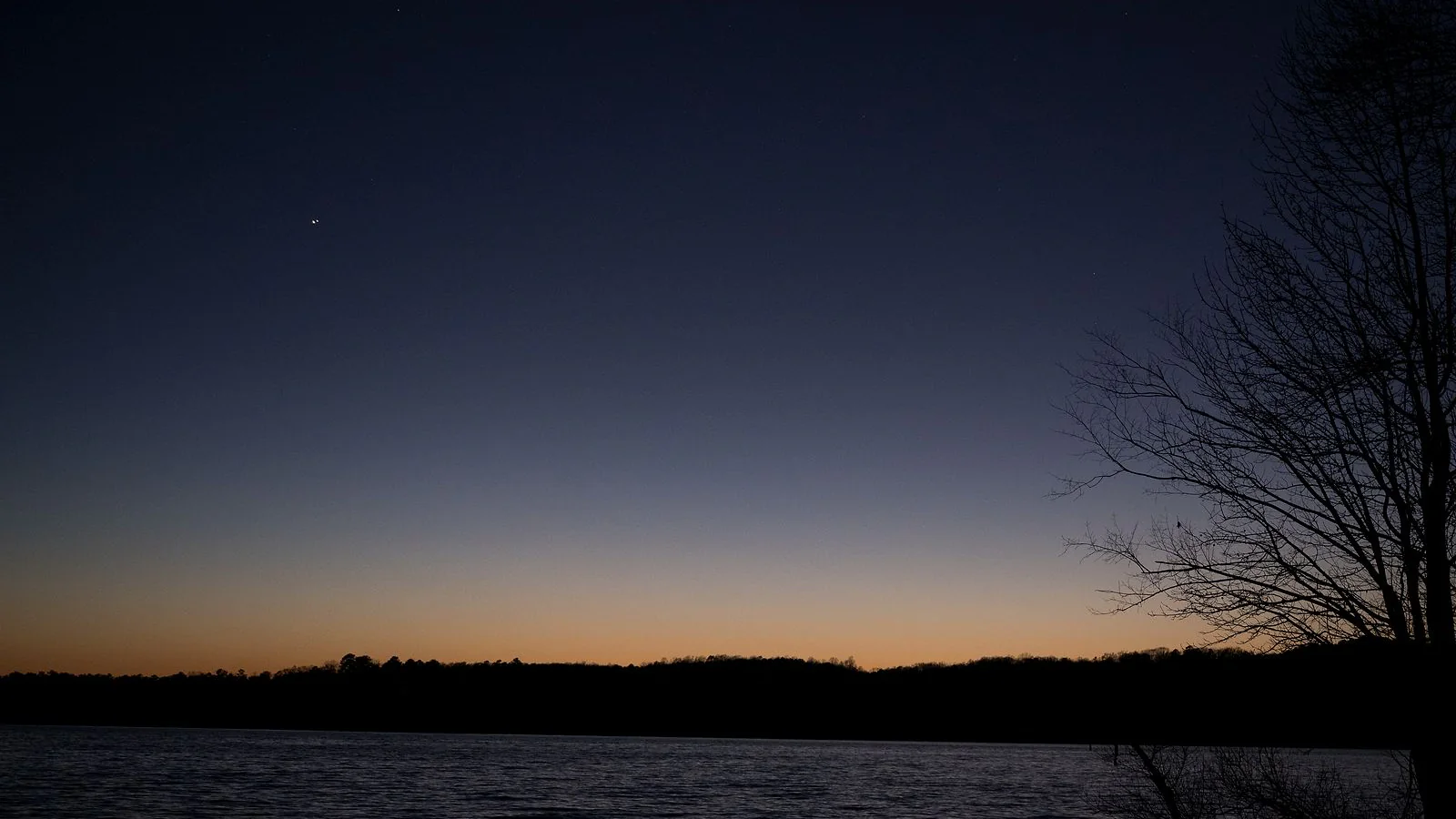
Less than the width of the full Moon, in the evening sky, after sunset
How close
Venus and Mars pass 0.3° apart in our sky — less than the width of the full Moon. Both fit in one view of ordinary binoculars, which take in five to seven degrees.
They are nowhere near each other in space: Venus is 218 million km from the Earth and Mars 334 million km. They only line up along our line of sight, as each moves along its own orbit.
Where to look
The pair is 27° from the Sun, in the evening sky, after sunset. Venus shines at magnitude −3.9 and Mars at 1.3; Venus is much the brighter of the two.
The separation changes slowly: the evening before and the evening after look much the same.
Computed by Orbira from NASA/JPL’s Keplerian elements for approximate positions of the major planets (valid 1800–2050): positions within a few arcminutes, so the date is right and the hour can be off by one or two. Magnitudes from the Astronomical Almanac’s formulae, good to a few tenths.
From these cities
For each city, the night nearest the date: when the pair can be seen — at least 5° above the horizon, with the Sun 6° or more below it — and its highest moment in that time.
| City | Visible, local time | Highest | Height and direction |
|---|---|---|---|
| London, United Kingdom | Not above the horizon while it is dark | — | — |
| Rome, Italy | Wed 24 Nov 17:20 – 17:40 | 17:20 | 8° up, south-west |
| Moscow, Russia | Not above the horizon while it is dark | — | — |
| New York, United States | Wed 24 Nov 17:10 – 17:30 | 17:10 | 8° up, south-west |
| Los Angeles, United States | Wed 24 Nov 17:20 – 17:50 | 17:20 | 11° up, south-west |
| Mexico City, Mexico | Wed 24 Nov 18:20 – 19:10 | 18:20 | 16° up, south-west |
| São Paulo, Brazil | Wed 24 Nov 19:00 – 20:00 | 19:00 | 20° up, west |
| Buenos Aires, Argentina | Wed 24 Nov 20:20 – 21:20 | 20:20 | 16° up, west |
| Cape Town, South Africa | Wed 24 Nov 20:10 – 21:10 | 20:10 | 17° up, west |
| Cairo, Egypt | Wed 24 Nov 17:30 – 18:00 | 17:30 | 12° up, south-west |
| Delhi, India | Wed 24 Nov 18:00 – 18:30 | 18:00 | 12° up, south-west |
| Beijing, China | Wed 24 Nov 17:30 – 17:50 | 17:30 | 8° up, south-west |
| Tokyo, Japan | Wed 24 Nov 17:00 – 17:30 | 17:00 | 11° up, south-west |
| Sydney, Australia | Wed 24 Nov 20:20 – 21:10 | 20:20 | 16° up, west |
| Auckland, New Zealand | Thu 25 Nov 20:50 – 21:50 | 20:50 | 17° up, west |
Computed by Orbira from NASA/JPL’s approximate planetary elements, ten minutes at a time; heights within about half a degree. Haze and buildings hide the lowest few degrees.
How to observe
- Both planets are bright enough to see with the naked eye from a city: look for two points of light that do not twinkle as stars do.
- Binoculars held steady show more; a small telescope shows Jupiter’s cloud bands and moons, Saturn’s rings, Mars’s colour and, at its closest, its polar cap.
- The days either side are almost as good: planets move slowly against the stars.