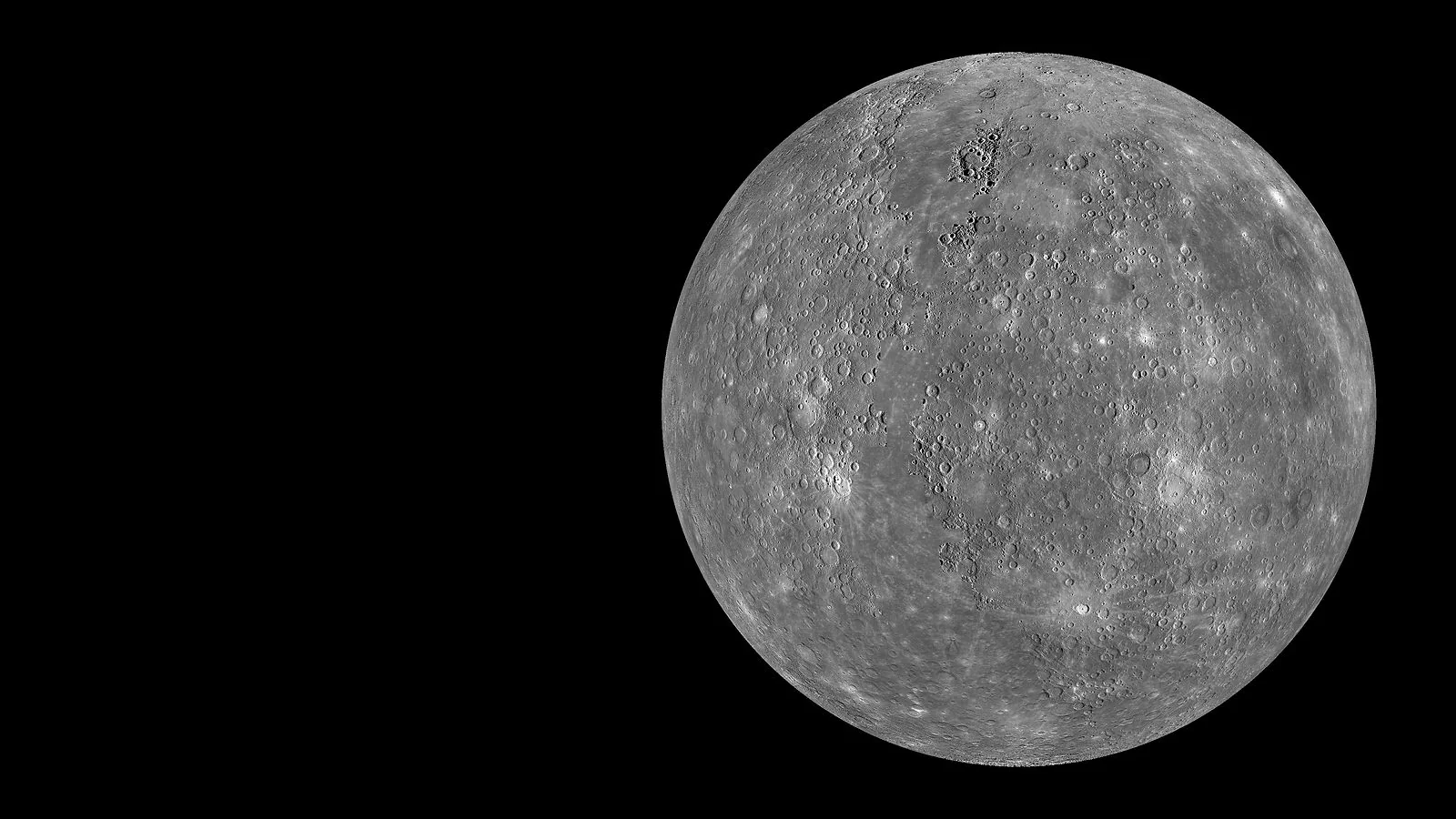
27.6° from the Sun in the morning sky, before sunrise · magnitude 0.2
What a greatest elongation is
Mercury orbits inside the Earth’s orbit, so from here it never strays far from the Sun: it swings to one side of it and back. At greatest elongation it stands farthest from the Sun in our sky — 27.6° this time — and has the most dark sky around it.
This one is western: Mercury is west of the Sun, so it rises before it and is seen in the east in the morning twilight.
Mercury never gets more than about 28° from the Sun, so it is only ever seen low down in twilight. Its greatest elongations, several a year, are the best chances to catch it; some are much better placed than others for a given hemisphere, which the table below shows.
How it looks
It shines at magnitude 0.2. Through a telescope it shows a phase like the Moon’s: about 54% of its disc is lit, 7.3 arcseconds across.
Computed by Orbira from NASA/JPL’s Keplerian elements for approximate positions of the major planets (valid 1800–2050): positions within a few arcminutes, so the date is right and the hour can be off by one or two. Magnitudes from the Astronomical Almanac’s formulae, good to a few tenths.
From these cities
For each city, the night nearest the date: when Mercury can be seen — at least 5° above the horizon, with the Sun 6° or more below it — and its highest moment in that time.
| City | Visible, local time | Highest | Height and direction |
|---|---|---|---|
| London, United Kingdom | Not above the horizon while it is dark | — | — |
| Rome, Italy | Not above the horizon while it is dark | — | — |
| Moscow, Russia | Not above the horizon while it is dark | — | — |
| New York, United States | Not above the horizon while it is dark | — | — |
| Los Angeles, United States | Wed 17 Mar 06:20 – 06:30 | 06:30 | 7° up, east |
| Mexico City, Mexico | Wed 17 Mar 05:50 – 06:20 | 06:20 | 14° up, east |
| São Paulo, Brazil | Wed 17 Mar 04:40 – 05:40 | 05:40 | 21° up, east |
| Buenos Aires, Argentina | Wed 17 Mar 05:10 – 06:20 | 06:20 | 20° up, east |
| Cape Town, South Africa | Wed 17 Mar 05:10 – 06:20 | 06:20 | 21° up, east |
| Cairo, Egypt | Wed 17 Mar 05:20 – 05:30 | 05:30 | 8° up, east |
| Delhi, India | Wed 17 Mar 05:40 – 06:00 | 06:00 | 9° up, east |
| Beijing, China | Not above the horizon while it is dark | — | — |
| Tokyo, Japan | Thu 18 Mar 05:20 – 05:20 | 05:20 | 7° up, east |
| Sydney, Australia | Thu 18 Mar 05:20 – 06:30 | 06:30 | 21° up, east |
| Auckland, New Zealand | Thu 18 Mar 05:40 – 06:50 | 06:50 | 20° up, east |
Computed by Orbira from NASA/JPL’s approximate planetary elements, ten minutes at a time; heights within about half a degree. Haze and buildings hide the lowest few degrees.
The next greatest elongations
Computed the same way, Mercury’s next 3 are:
| Date (UTC) | Side | Angle from the Sun |
|---|---|---|
| 28 May 2027 | Evening (eastern) | 22.9° |
| 15 Jul 2027 | Morning (western) | 20.7° |
| 24 Sep 2027 | Evening (eastern) | 26.3° |
How to observe
- No equipment is needed: a planet is a steady point of light that does not twinkle as a star does.
- It is low and in twilight: find a place with a clear, flat horizon in the right direction, and start looking soon after sunset or before sunrise. Never sweep with binoculars while any part of the Sun is above the horizon.
- The days either side are almost as good: planets move slowly against the stars.