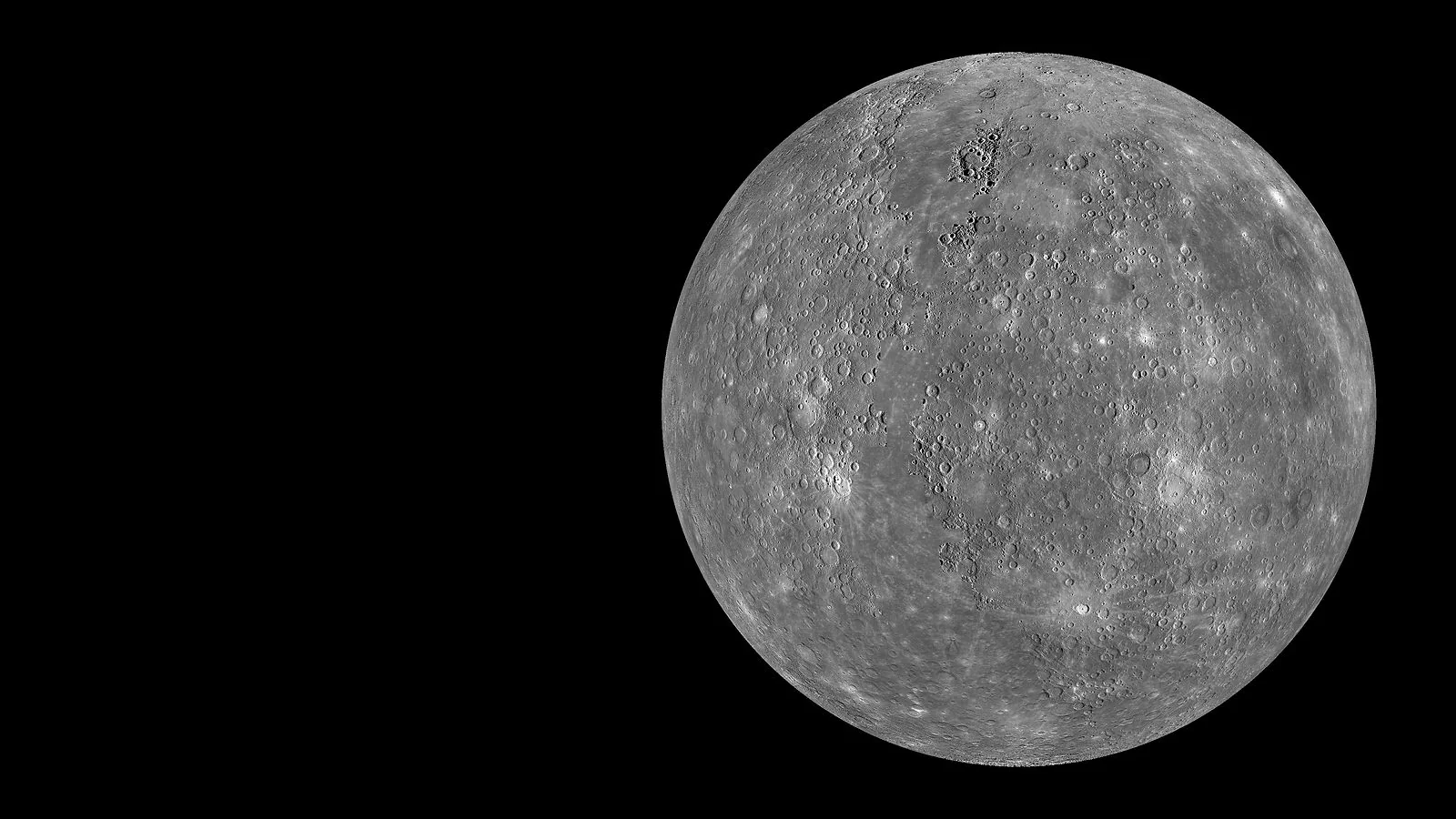
26.3° from the Sun in the evening sky, after sunset · magnitude 0.1
What a greatest elongation is
Mercury orbits inside the Earth’s orbit, so from here it never strays far from the Sun: it swings to one side of it and back. At greatest elongation it stands farthest from the Sun in our sky — 26.3° this time — and has the most dark sky around it.
This one is eastern: Mercury is east of the Sun, so it sets after it and is seen in the west in the evening twilight.
Mercury never gets more than about 28° from the Sun, so it is only ever seen low down in twilight. Its greatest elongations, several a year, are the best chances to catch it; some are much better placed than others for a given hemisphere, which the table below shows.
How it looks
It shines at magnitude 0.1. Through a telescope it shows a phase like the Moon’s: about 59% of its disc is lit, 6.9 arcseconds across.
Computed by Orbira from NASA/JPL’s Keplerian elements for approximate positions of the major planets (valid 1800–2050): positions within a few arcminutes, so the date is right and the hour can be off by one or two. Magnitudes from the Astronomical Almanac’s formulae, good to a few tenths.
From these cities
For each city, the night nearest the date: when Mercury can be seen — at least 5° above the horizon, with the Sun 6° or more below it — and its highest moment in that time.
| City | Visible, local time | Highest | Height and direction |
|---|---|---|---|
| London, United Kingdom | Not above the horizon while it is dark | — | — |
| Rome, Italy | Not above the horizon while it is dark | — | — |
| Moscow, Russia | Not above the horizon while it is dark | — | — |
| New York, United States | Not above the horizon while it is dark | — | — |
| Los Angeles, United States | Not above the horizon while it is dark | — | — |
| Mexico City, Mexico | Fri 24 Sept 19:00 – 19:10 | 19:00 | 9° up, west |
| São Paulo, Brazil | Fri 24 Sept 18:30 – 19:30 | 18:30 | 19° up, west |
| Buenos Aires, Argentina | Fri 24 Sept 19:20 – 20:20 | 19:20 | 19° up, west |
| Cape Town, South Africa | Fri 24 Sept 19:10 – 20:20 | 19:10 | 20° up, west |
| Cairo, Egypt | Fri 24 Sept 19:20 – 19:20 | 19:20 | 6° up, west |
| Delhi, India | Fri 24 Sept 18:40 – 18:50 | 18:40 | 8° up, west |
| Beijing, China | Not above the horizon while it is dark | — | — |
| Tokyo, Japan | Not above the horizon while it is dark | — | — |
| Sydney, Australia | Fri 24 Sept 18:20 – 19:20 | 18:20 | 19° up, west |
| Auckland, New Zealand | Fri 24 Sept 18:50 – 19:50 | 18:50 | 19° up, west |
Computed by Orbira from NASA/JPL’s approximate planetary elements, ten minutes at a time; heights within about half a degree. Haze and buildings hide the lowest few degrees.
The next greatest elongations
Computed the same way, Mercury’s next 3 are:
| Date (UTC) | Side | Angle from the Sun |
|---|---|---|
| 4 Nov 2027 | Morning (western) | 18.8° |
| 17 Jan 2028 | Evening (eastern) | 18.8° |
| 27 Feb 2028 | Morning (western) | 26.9° |
How to observe
- No equipment is needed: a planet is a steady point of light that does not twinkle as a star does.
- It is low and in twilight: find a place with a clear, flat horizon in the right direction, and start looking soon after sunset or before sunrise. Never sweep with binoculars while any part of the Sun is above the horizon.
- The days either side are almost as good: planets move slowly against the stars.