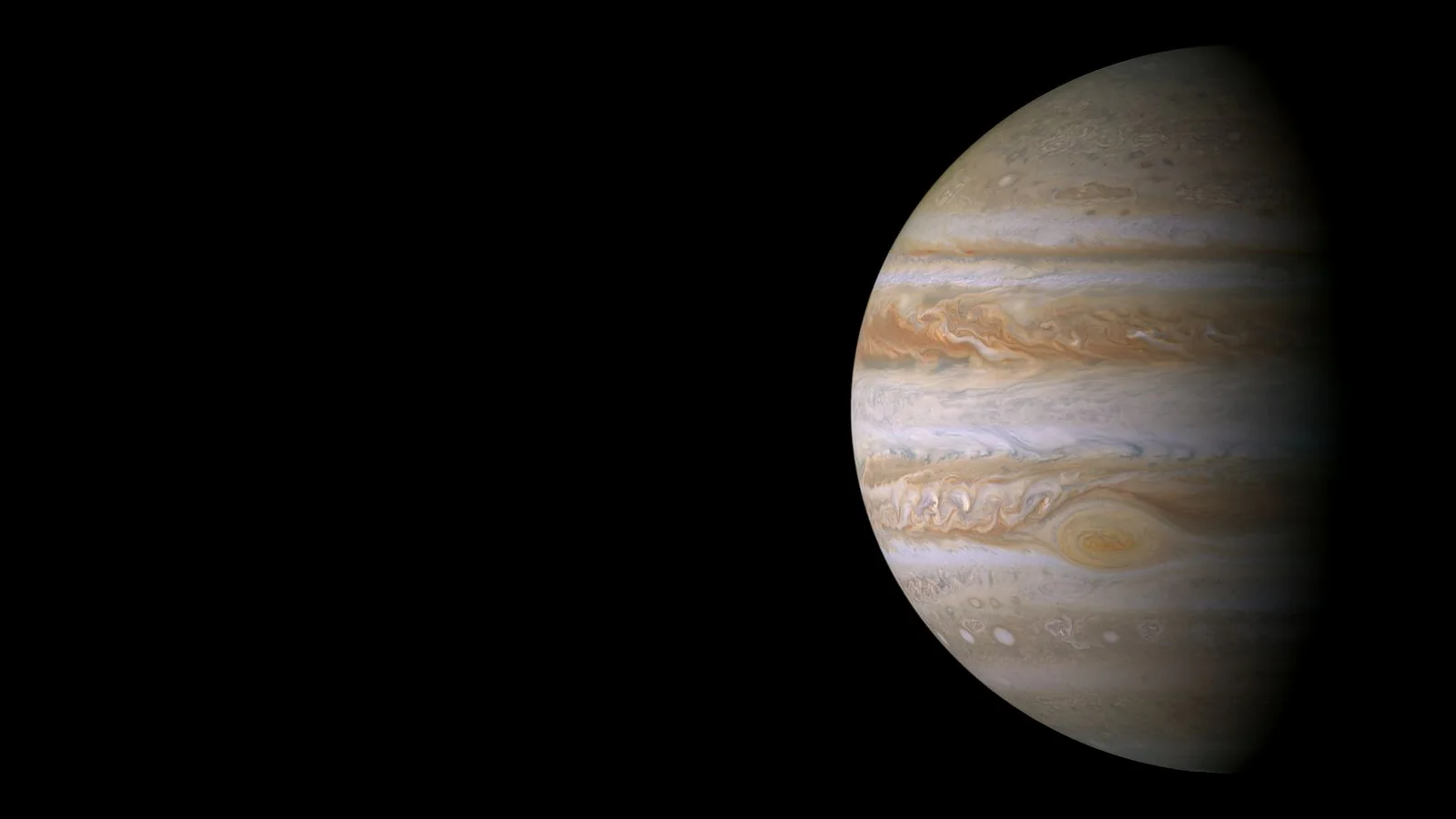
Up all night, near its brightest: magnitude −2.6, 652 million km away
What an opposition is
The Earth moves round the Sun faster than Jupiter, and about every 399 days it overtakes it on the inside. At that moment the Sun, the Earth and Jupiter line up, and Jupiter is opposite the Sun in our sky: it rises in the east as the Sun sets, is highest around midnight and sets in the west as the Sun rises.
It is the best time to see it. Jupiter is up all night, at about its closest to the Earth and so near its brightest, and its fully lit face is turned towards us.
How bright, how far
On 11 Feb 2027 Jupiter is 652 million km from the Earth and shines at magnitude −2.6 — brighter than any star. Through a telescope its disc is 45.2 arcseconds across.
Ordinary binoculars held steady show its four largest moons — Io, Europa, Ganymede and Callisto — as points of light in a line beside it, changing places from night to night.
Computed by Orbira from NASA/JPL’s Keplerian elements for approximate positions of the major planets (valid 1800–2050): positions within a few arcminutes, so the date is right and the hour can be off by one or two. Magnitudes from the Astronomical Almanac’s formulae, good to a few tenths.
From these cities
For each city, the night nearest the date: when Jupiter can be seen — at least 5° above the horizon, with the Sun 6° or more below it — and its highest moment in that time.
| City | Visible, local time | Highest | Height and direction |
|---|---|---|---|
| London, United Kingdom | Wed 10 Feb 17:50 – 06:40 | 00:10 | 54° up, south |
| Rome, Italy | Wed 10 Feb 18:10 – 06:40 | 00:20 | 63° up, south |
| Moscow, Russia | Wed 10 Feb 18:10 – 07:20 | 00:40 | 50° up, south |
| New York, United States | Wed 10 Feb 18:00 – 06:20 | 00:10 | 65° up, south |
| Los Angeles, United States | Wed 10 Feb 18:00 – 06:10 | 00:10 | 71° up, south |
| Mexico City, Mexico | Wed 10 Feb 19:00 – 06:40 | 00:50 | 86° up, south |
| São Paulo, Brazil | Wed 10 Feb 19:20 – 05:20 | 00:20 | 51° up, north |
| Buenos Aires, Argentina | Wed 10 Feb 20:20 – 05:50 | 01:10 | 40° up, north |
| Cape Town, South Africa | Wed 10 Feb 20:20 – 05:50 | 01:00 | 41° up, north |
| Cairo, Egypt | Wed 10 Feb 18:10 – 06:10 | 00:10 | 75° up, south |
| Delhi, India | Wed 10 Feb 18:40 – 06:30 | 00:40 | 77° up, south |
| Beijing, China | Wed 10 Feb 18:20 – 06:40 | 00:30 | 65° up, south |
| Tokyo, Japan | Wed 10 Feb 17:50 – 06:00 | 00:00 | 70° up, south |
| Sydney, Australia | Wed 10 Feb 20:30 – 05:50 | 01:10 | 41° up, north |
| Auckland, New Zealand | Thu 11 Feb 21:00 – 06:10 | 01:30 | 38° up, north |
Computed by Orbira from NASA/JPL’s approximate planetary elements, ten minutes at a time; heights within about half a degree. Haze and buildings hide the lowest few degrees.
The next oppositions
Computed the same way, Jupiter’s next 3 are:
| Date (UTC) | Distance | Magnitude |
|---|---|---|
| 12 Mar 2028 | 664 million km | −2.5 |
| 12 Apr 2029 | 666 million km | −2.5 |
| 13 May 2030 | 656 million km | −2.5 |
How to observe
- No equipment is needed: a planet is a steady point of light that does not twinkle as a star does.
- Binoculars held steady show more; a small telescope shows Jupiter’s cloud bands and moons, Saturn’s rings, Mars’s colour and, at its closest, its polar cap.
- The days either side are almost as good: planets move slowly against the stars.