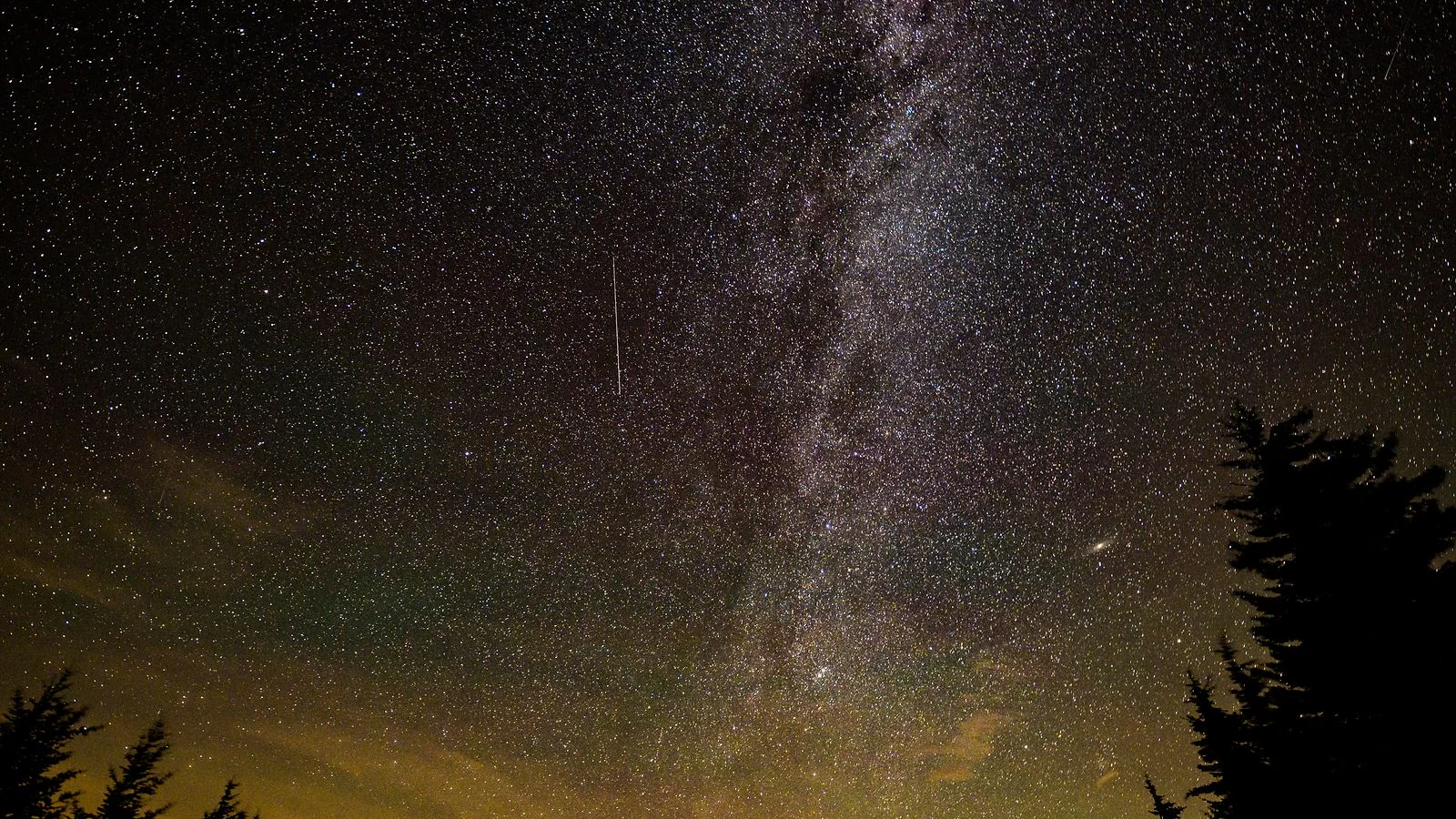
Up to 80+ meteors an hour under a dark sky · best from the northern hemisphere
What you will see
At their peak the Quadrantids can produce up to 80+ meteors an hour for one observer under a perfectly dark sky. They seem to fly out of one point in Boötes — the radiant — but they can appear anywhere in the sky, so there is no need to stare at the constellation itself.
They strike the atmosphere at 41 km/s, about 148,000 km/h, and burn up high above the ground, typically between 70 and 120 km up.
Where they come from
The Quadrantids are debris shed by most likely the asteroid 2003 EH1, thought to be the remains of an old comet. Every year the Earth crosses that trail of dust between 28 Dec and 12 Jan. Most of the grains are smaller than a grain of sand; it is their speed, not their size, that makes them shine.
The peak comes when the Earth passes through the densest part of the trail, at the same point of its orbit every year — solar longitude 283.15° in IMO's calendar, which this year falls around 03:00 UT on 4 Jan. A given return can peak some hours either side.
The Moon on the peak night
At the peak the Moon is a waning crescent, 12% lit. Its light will barely interfere — a good year for this shower.
Moon phase computed at the estimated peak (Meeus, low-accuracy formula).
What the rate means
80+ is the zenithal hourly rate (ZHR): what one observer would count in an hour if the sky were perfectly dark — stars visible down to magnitude 6.5 — and the radiant were straight overhead. Real counts are almost always lower.
With the radiant 30° above the horizon you would see about half of it; under a suburban sky, a third or less. Best from the Northern Hemisphere. Showers are usually richest after midnight, when your side of the Earth faces forward along its orbit and sweeps up more of the dust.
From these cities
For each city, the dark hours of the night nearest the peak (the Sun at least 12° below the horizon), the moment in them when the radiant stands highest, and how many meteors one observer could count in an hour then under a perfectly dark sky: the ZHR scaled by the radiant’s height. Under city lights, expect a fraction of that.
The Moon’s place at that moment says whether its light is in the way.
| City | Dark, local time | Best moment | Radiant | Moon then | Up to, per hour |
|---|---|---|---|---|---|
| Moscow, Russia | Sun 3 Jan 17:52 – 07:22 | 07:22 | 74° up, up all night | 12% lit, 3° up | 77 |
| London, United Kingdom | Sun 3 Jan 17:32 – 06:42 | 06:42 | 73° up, up all night | 11% lit, 5° up | 77 |
| New York, United States | Sun 3 Jan 17:52 – 06:12 | 06:12 | 66° up, rises 21:02 | 10% lit, 9° up | 73 |
| Rome, Italy | Sun 3 Jan 18:02 – 06:22 | 06:22 | 66° up, up all night | 11% lit, 10° up | 73 |
| Beijing, China | Sun 3 Jan 18:12 – 06:32 | 06:32 | 65° up, rises 21:52 | 13% lit, 14° up | 73 |
| Tokyo, Japan | Mon 4 Jan 17:42 – 05:42 | 05:42 | 61° up, rises 22:32 | 8% lit, 8° up | 70 |
| Los Angeles, United States | Sun 3 Jan 18:02 – 05:52 | 05:52 | 59° up, rises 23:02 | 9% lit, 11° up | 69 |
| Cairo, Egypt | Sun 3 Jan 18:12 – 05:52 | 05:52 | 56° up, rises 23:42 | 12% lit, 17° up | 66 |
| Delhi, India | Sun 3 Jan 18:32 – 06:12 | 06:12 | 54° up, rises 00:22 | 13% lit, 18° up | 65 |
| Mexico City, Mexico | Sun 3 Jan 19:12 – 06:12 | 06:12 | 45° up, rises 01:32 | 10% lit, 17° up | 57 |
| São Paulo, Brazil | Sun 3 Jan 20:02 – 04:22 | — | Below the horizon all night | 11% lit, 22° up | Few, if any |
| Sydney, Australia | Mon 4 Jan 21:22 – 04:42 | — | Below the horizon all night | 9% lit, 16° up | Few, if any |
| Cape Town, South Africa | Sun 3 Jan 21:12 – 04:32 | — | Below the horizon all night | 12% lit, 21° up | Few, if any |
| Buenos Aires, Argentina | Sun 3 Jan 21:22 – 04:32 | — | Below the horizon all night | 11% lit, 18° up | Few, if any |
| Auckland, New Zealand | Mon 4 Jan 21:52 – 04:52 | — | Below the horizon all night | 9% lit, 15° up | Few, if any |
Computed by Orbira: the Sun, the Moon and the radiant from low-precision formulae, ten minutes at a time; the rate is ZHR × sin(radiant height), IMO’s formula for a perfectly dark sky. The real peak can come hours either side of IMO’s mean.
How to observe
- Find a dark place away from city lights and give your eyes about twenty minutes to adapt.
- Lie back and look at a wide area of sky: meteors appear all over it, not only near the radiant.
- The rate here is an ideal. Moonlight, light pollution and a low radiant mean most people see far fewer.